The AI Paradox, one year later
Last November in Dubai I made five predictions about software in the age of AI. Twelve months on, I want to grade them against hard evidence.
Last November I stood on a stage at DOERS Summit in Dubai and gave a talk called The AI Paradox: Software Abundance, Scarcity and Being Irreplaceable. The idea was simple. When something becomes abundant, value moves to whatever stays scarce. AI was about to make software abundant, so I tried to predict what would become scarce.
I made five predictions. I said software would become disposable, that curation would matter more than creation, that craftsmen with cult-like communities would win, that people would pay a premium for things made by humans, and that money and talent would flee the screen for the machine: deep tech, energy, robotics.
The original slides
The deck from my DOERS Summit Dubai talk, November 2025. Free to download and share.
A year is a short time for predictions like these, but it's been a very long year in AI. So I did what I'd want anyone else to do with their predictions: I went back and checked them against the evidence. Some of it flatters me. Some of it doesn't.
The year in one paragraph
Since that talk we got Gemini 3, Claude Opus 4.5, a GPT-5 point release roughly every quarter, and, just in the last eight weeks, GPT-6, Claude Opus 5.5 and Gemini 4. Anthropic's revenue run-rate went from about $9 billion at the end of 2025 to more than $47 billion by May1. OpenAI raised $122 billion at an $852 billion valuation2. In February, after Anthropic shipped industry plugins for Claude Cowork, software stocks had their worst day in years and Thomson Reuters fell almost 16% in a single session3. The average S&P 500 software stock ended up 27% down by April, and the market started calling it the "SaaSpocalypse"4. Meanwhile layoffs kept coming, more and more of them explicitly blamed on AI. That's the backdrop. Now the scorecard.
- 1 Right
- 3 Partly right
- 1 Too early
| Prediction | What I said | Verdict |
|---|---|---|
| 01Disposable | Most software becomes a temporary utility | Partly rightRight on creation, early on distribution |
| 02Curated | Filtering beats making; taste beats dev skill | Right |
| 03Crafted | Craftsmen with cult-like communities win | Too earlyMixed, early |
| 04Human | We'll pay a premium for human-made | Partly rightRight as a signal, unproven as a price |
| 05Deep | Capital flees the screen for the machine | Partly rightHalf right |
01. Disposable software: right about who builds, wrong about where it goes
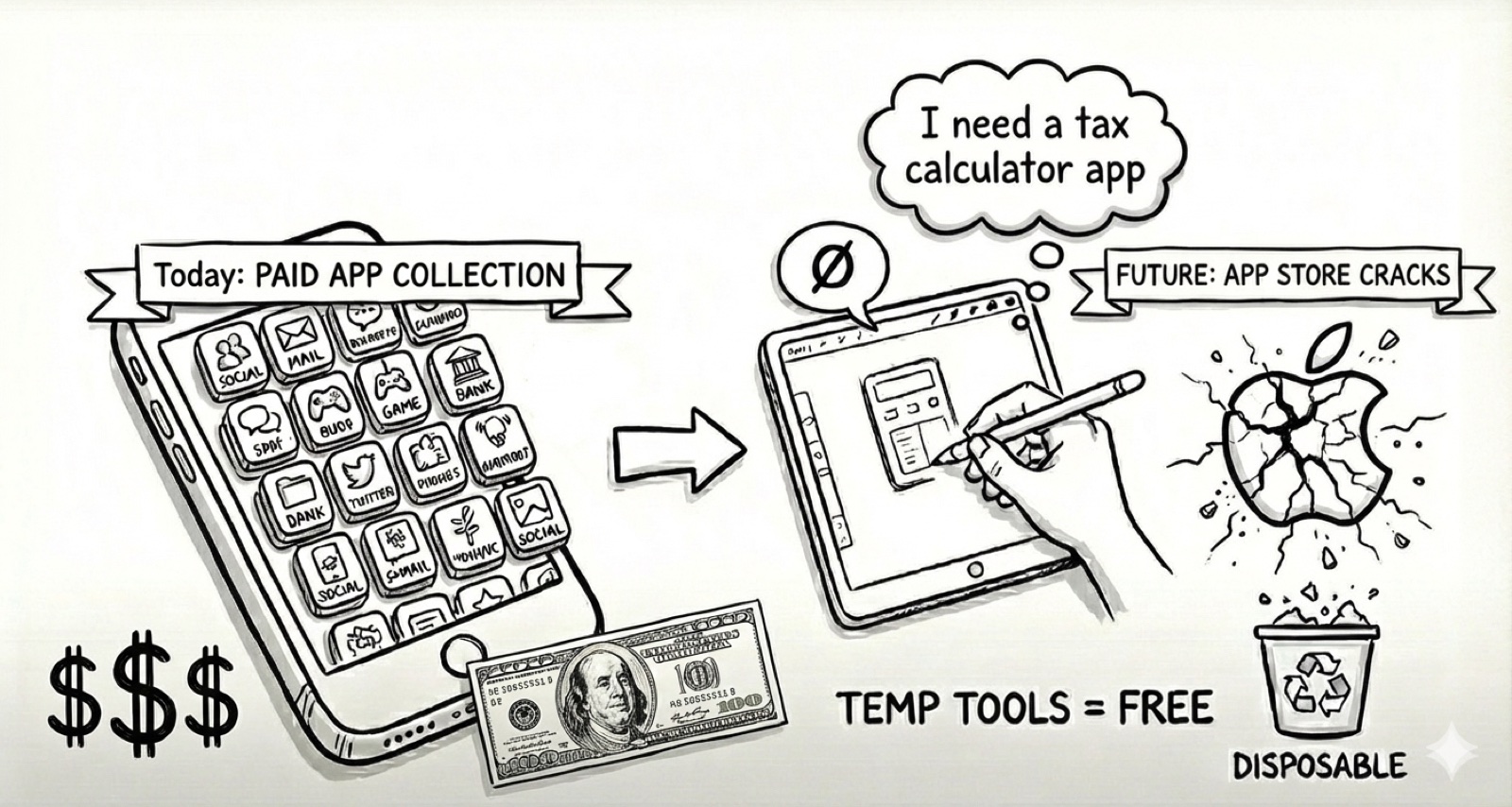
My claim was that simple tools, apps and games would increasingly be built by their users, often for one job and then thrown away. "There's an app for that" would become "there's a prompt for that", and people would skip the app store for a lot of use cases. Complex products would still be built by professionals, and those would stay paid and permanent.
The creation half happened faster than I expected. Lovable, the poster child of what everyone now calls vibe coding, says more than 60 million projects have been created on it, and the apps people built there get over 900 million visits a month. It raised at a $13.3 billion valuation in August5. Replit tripled its valuation to $9 billion in six months6. Even the phrase "disposable software" went mainstream: you can find it in a16z essays and in Fivetran's product marketing7.
The distribution half didn't go the way I said. People didn't skip the app store. They flooded it. Apple's App Store added roughly 560,000 new apps in the first half of 2026, about as many as in all of 2025. Downloads in the same period grew by 2%8. That's what abundance looks like: supply doubles, demand doesn't move. Apple also pushed back on the tools themselves, blocking updates to vibe-coding apps like Replit's and pulling one off the store in March9. ChatGPT opened an app directory in December10, but I couldn't find any credible usage numbers showing people prompt their way past the store at scale.
Where the long tail did escape the store, it didn't do it with prompts. It shipped as a link, a desktop app or a repo. Lovable builds web apps by default; getting one into the App Store means wrapping it yourself67. When Apple froze updates to vibe-coding apps, the fix it reportedly asked for was to open the generated apps in an external browser9. A US court forced Apple to let apps send people to checkout on the web, and Spotify did it within days68. The two agent products of the year, Anthropic's Cowork and OpenAI's Codex app, launched as Mac desktop apps, outside any store6970. OpenClaw, an open-source agent that runs on your own machine and talks to you through WhatsApp or Telegram, went from a weekend project to almost 200,000 GitHub stars in ten weeks71. GitHub counted 121 million new repositories in a year, its biggest year ever, although most of the work now happens in private repos72. Open isn't winning by default. The disposable layer just lives wherever the store isn't.
And the "complex products stay paid and permanent" half? Also true, maybe too true for anyone hoping SaaS would die. Salesforce grew revenue 10% to $41.5 billion in its last fiscal year11, and the software stocks that crashed in spring had recovered almost all of it by late September4. On Hacker News this month, an Ars Technica piece summed up the mood in its headline: AI coding agents generate more code, but not more software12.
Verdict: right on creation, early on distribution. The two-tier world I described is real. There's a vast, mostly throwaway long tail, and a durable professional core. I underestimated how much of the long tail would still try to live inside the old stores, and how much of the rest would route around them through the browser, the desktop and GitHub.
02. Curation is essential: the clearest win
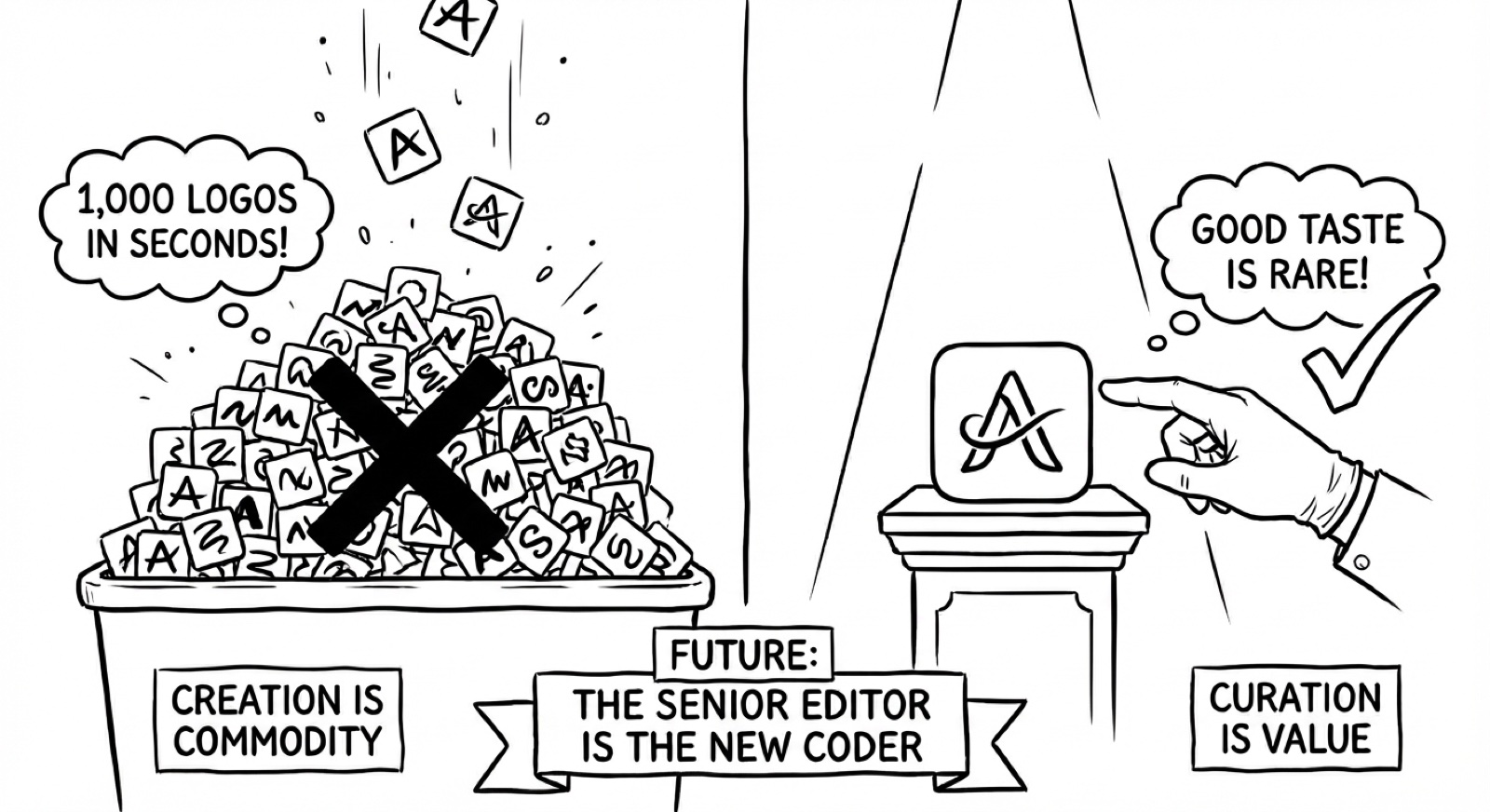
This was the prediction I felt most strongly about: when the cost of making things drops to zero, the value of average work collapses, and the bottleneck moves from making to editing. Generating a thousand logos takes five seconds. Knowing which one is good takes a lifetime of taste.
The evidence here is almost comically strong. Merriam-Webster's word of the year for 2025 was slop13. By July, more than half of all tracks uploaded to Deezer every day were AI-generated, up from about a third last November14. The curl project shut down its bug bounty in January because AI-written reports were drowning maintainers15. This month QGIS put a moratorium on AI-generated contributions16, and Steam players are asking for a "no AI" filter because AI-made games are flooding its Next Fest showcase17.
The same thing happened inside engineering teams, and that's the part I find most interesting. The most-discussed thread about code on Hacker News this October was literally titled "How to deal with shipping AI-written code you don't understand?" (621 points, 762 comments)18. The top answers: design the abstractions yourself, let the model implement them, and treat a strong test suite as your new code review. In other words: become the editor. Andrej Karpathy put it more starkly, according to Business Insider's write-up of his post. There's a widening gap between the handful of people who understand what these models can do and everyone else, and even people at the frontier can't review the output fast enough19. The developer data agrees. In Stack Overflow's 2026 survey, released this month, only 6.6% of developers said they trust AI output for important decisions20.
Platforms now curate too. YouTube clarified that templated, "inauthentic" AI content can't be monetized21. And "taste is the moat" became such a cliché that one designer called it possibly the industry's favorite sentence of 202622.
The same thing is happening to apps. With half a million new apps in six months, the store shelf no longer works as a filter, so people pick apps through people. In an April survey of 4,000 US and UK app users, friends and family were the top way to find an app (38%), ahead of search (32%) and social media and store browsing (29% each). AI tools came last at 10%, and only 44% of people trust what AI recommends73. Cal AI, a photo calorie counter two teenagers grew through influencer marketing, reached 15 million downloads, and MyFitnessPal bought it in March7475. Apple, meanwhile, is selling more of its own shelf, with more search-ad slots in App Store results from 202676. And when trust is the scarce thing, people fake it, which is why the FTC now bans AI-generated reviews and bought followers77.
One honest caveat: the flood is mostly ignored rather than consumed. On Deezer, AI tracks are over half of uploads but only 1–3% of streams23. Curation works, but someone has to pay for it, and so far it's mostly platforms and exhausted maintainers.
Verdict: right. The scarce skill isn't producing. It's knowing what's good, and being trusted to say so.
03. The craftsman cult: mixed, and probably early
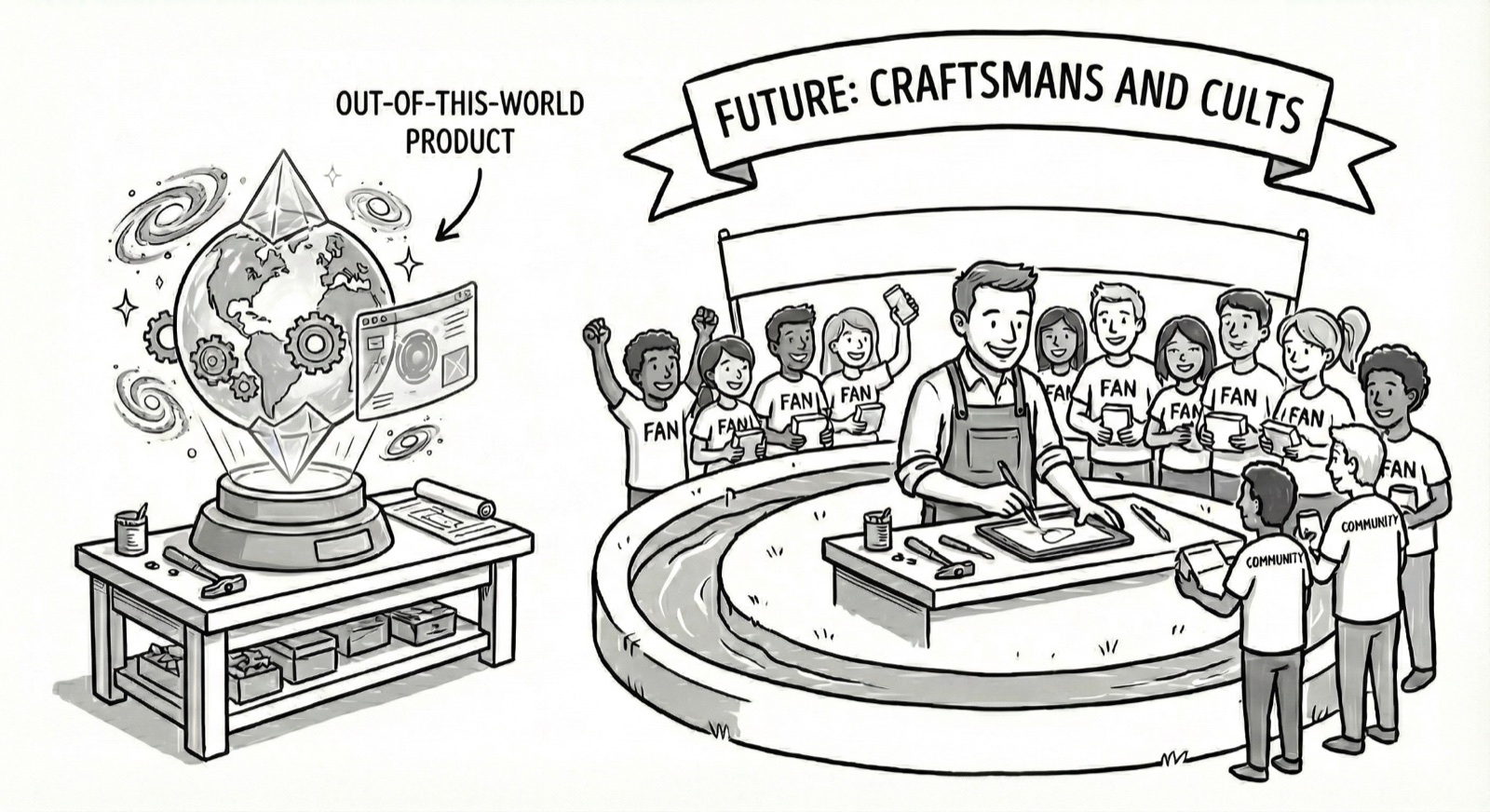
My third prediction was that the value would move to people crafting unique, often partly offline experiences for fanatical communities, and that their moat would be direct distribution: YouTube, email, events. A cult, I said, is the one thing an algorithm can't fork.
The signals point the right way, but the hard data is thin. Eventbrite found 79% of people aged 18–29 plan to go to more events in 2026, and running-plus-coffee meetups grew 233%24. Beehiiv expects revenue to nearly double this year25. US vinyl sales passed a billion dollars, the 19th straight year of growth26. Linear, probably the best example of craft in B2B software, is reportedly above $100 million in ARR with net revenue retention of 177%27. And Karri Saarinen, Linear's co-founder, wrote one of the most-shared posts of the month on HN, "Someone behind the software"28, arguing that what people buy is the intent and care of the people behind a product, not the code. Dylan Field made the same case from the tools side this month: models learn from what already exists, so on their own they drift towards the average, and AI lowers the floor for everyone while the best people use it to raise the ceiling78. The craftsman's opening is the gap between those two.
AI piles work up at the average
How much work exists at each level of quality, made by hand and made with AI. Illustrative.
Made by handMade with AI
Relative amount of work
| Quality | Made by hand | Made with AI |
|---|---|---|
| Poor | 1 | 0 |
| Poor | 3 | 0 |
| Poor | 6 | 0 |
| Poor | 12 | 0 |
| Weak | 21 | 0 |
| Weak | 34 | 1 |
| Weak | 50 | 8 |
| Weak | 68 | 37 |
| Average | 84 | 111 |
| Average | 96 | 216 |
| Average | 100 | 270 |
| Average | 96 | 216 |
| Good | 84 | 111 |
| Good | 68 | 37 |
| Good | 50 | 8 |
| Good | 34 | 1 |
| Exceptional | 21 | 3 |
| Exceptional | 12 | 13 |
| Exceptional | 6 | 22 |
| Exceptional | 3 | 13 |
| Exceptional | 1 | 3 |
The programming community itself is having a craft moment, and it's an emotional one. "It's still ok to enjoy programming" got 706 points29, and threads about keeping the joy of programming alive are everywhere. DHH said at Rails World that he's put the pencil down and no longer writes code by hand30. In the same breath, people now joke that anyone still coding without an LLM is by definition an "artisan software developer". The craft hasn't died. It's become a choice.
But the counter-evidence is real. The Browser Company, the ultimate craft-software cult, sold to Atlassian, and Arc was discontinued31. Most attention didn't move to small, beloved creators. It consolidated into a handful of AI platforms with hundreds of millions of users each.
Verdict: mixed and early. I still believe it. I'd just give it three years, not one.
04. The human premium: right as a signal, unproven as a price
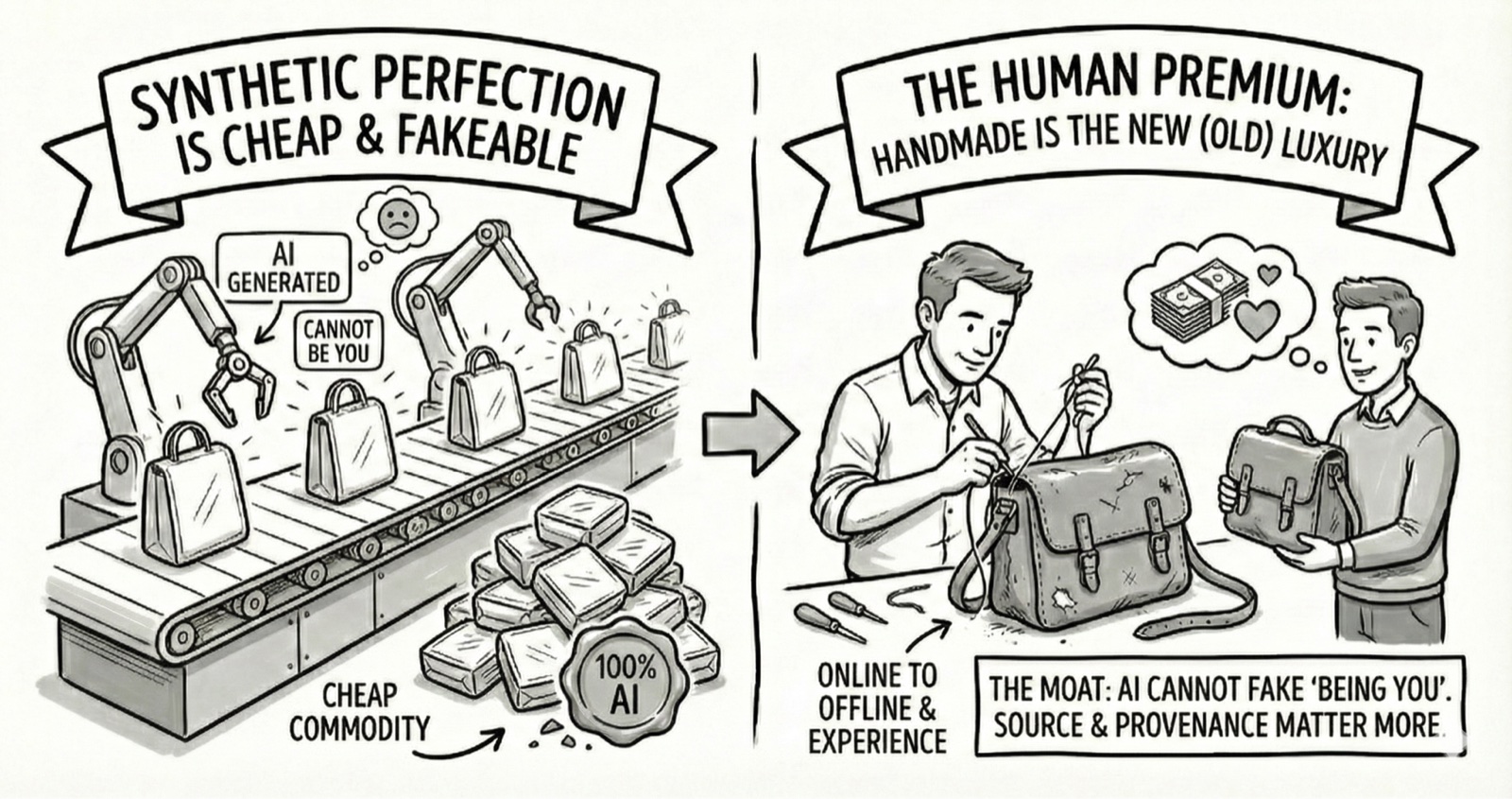
I argued that as synthetic perfection gets cheap, "human-made" becomes the new luxury: we'd pay for flaws, nuance and provenance, and "100% human verified" would become a stamp of value, the way "handmade in Italy" is.
The labels arrived on schedule. By March the BBC counted at least eight competing efforts to certify human-made work32. A Human Made Mark for film and TV launched in April33. World, Sam Altman's proof-of-personhood project, says around 18 million people have verified with its Orb, and it's now integrated with Tinder, Zoom and Docusign34. The backlash is real too. McDonald's Netherlands pulled its AI Christmas ad three days after launch35. And this September LibreOffice made the absence of AI a selling point, to applause on Hacker News36.
But the price part is where I was too confident. Surveys keep showing that people say they prefer human work much more than they'll pay for it. In one study, roughly half of consumers said they'd pay the same or more for AI-made films, and only about half could even tell the difference37. In another, two thirds said they wouldn't pay extra for fully human-made content38. An AI-generated act topped a Billboard country sales chart last November39.
Verdict: right as a signal, unproven as a price. "Human" has become a brand attribute and a trust signal. It isn't a reliable price premium yet, except where provenance itself is the product: art, journalism, education, and anything where you're really buying the person.
05. Deep tech is the last stand: half right
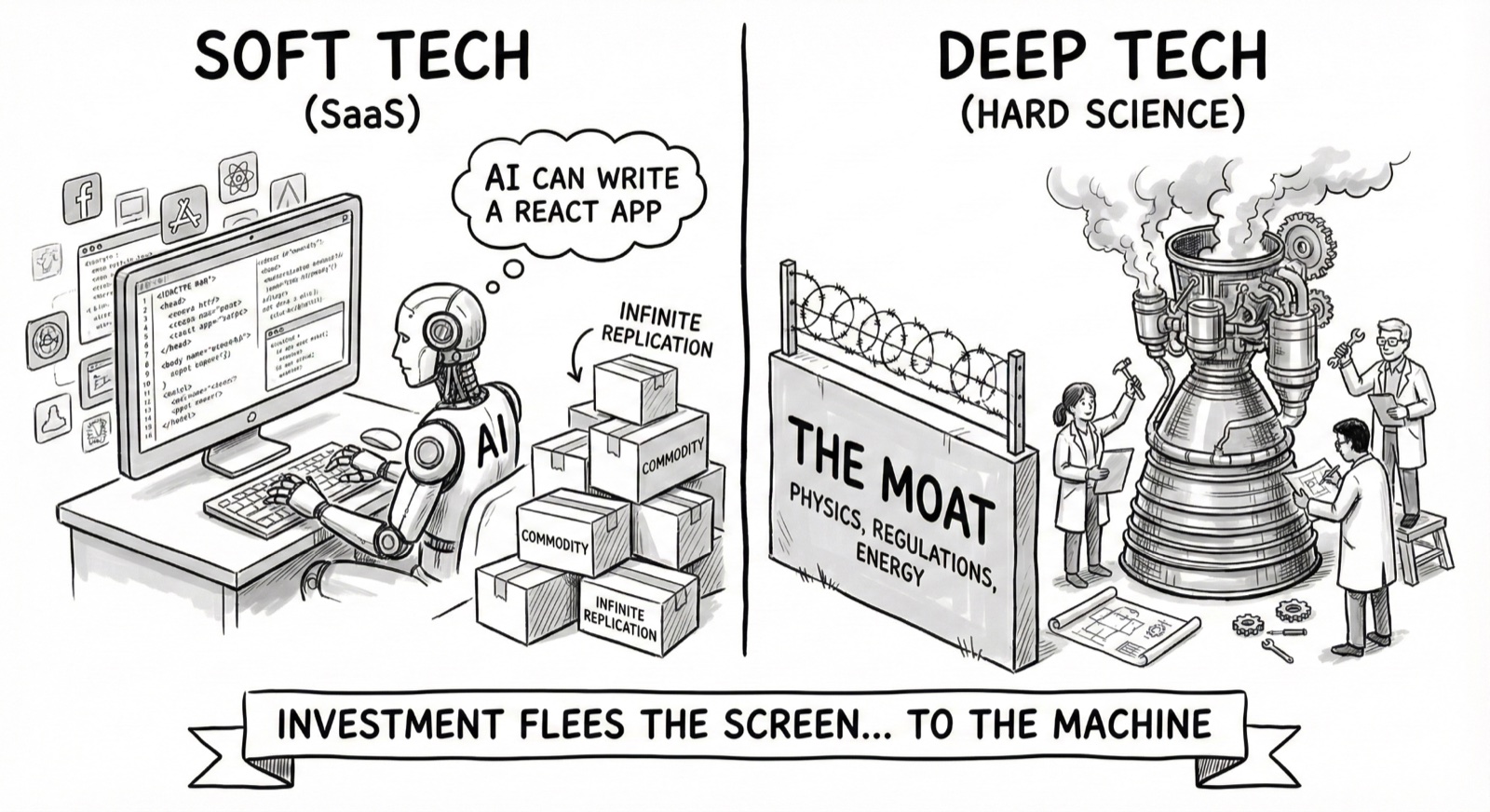
My last prediction was the boldest: if something can be fully digitized, it becomes a commodity. AI can write a React app, but it can't hallucinate a working rocket engine. So developers and investment would flee the screen and flood the machine, and energy, not code, would be the moat.
The machine side of that came true in a big way. Defense tech startups raised $14.6 billion in the first five months of 2026, already more than the record for all of 2025, and Anduril raised $5 billion at a $61 billion valuation40. Fusion companies raised a record $4.5 billion over the past year41. Meta signed nuclear deals for up to 6.6 gigawatts42. And the grid really did become the moat. PJM, the largest US grid operator, came in roughly 6.6 gigawatts short in its December capacity auction, a first, at record prices, and is now running an emergency auction whose costs are being steered toward data centers43. I wrote about this in my deep dive on AI data centers, and it's only gotten more true.
But I was wrong about "flee". Money didn't leave software for the machine. It flooded AI software. In the first half of 2026, AI took 86% of all US venture dollars, mostly OpenAI and Anthropic44. In Q3, AI was still 64% of global venture funding. Robotics, aerospace, semiconductors, energy and data centers each raised more than $10 billion, though a lot of that "deep tech" money is really infrastructure for AI software45. And SaaS public markets, after the worst spring in a decade, mostly bounced back4.
Verdict: half right. The machine is booming, and power is the real constraint. But software didn't lose the capital war. The capital just concentrated into the few companies building the models.
What I didn't see coming
Three things weren't anywhere in my slides.
Code got cheap; understanding got expensive. I framed the shift as creation versus curation. Inside companies, it turned out to be about comprehension. A post that went viral in September described engineers at a new job working 12–13 hours "just to press enter" on whatever Claude Code generated46. That's the dystopian version of the editor role I described. The better version is the HN consensus: design the system yourself, let the model fill it in, and let your tests be the gate.
The juniors. I talked about senior editors becoming more valuable. I didn't talk about what happens to the people who were supposed to become senior editors. Entry-level software postings have collapsed. By one count only 4.5% of US software job postings in Q1 were entry-level47. Stanford's research found a roughly 20% drop in employment for developers aged 22–25 since late 2022, though economists still argue about how much of that is AI and how much is interest rates48. If taste comes from years of doing the work, we're quietly cutting off the supply of future taste. That worries me more than anything else here.
Security. The biggest AI story on Hacker News in this period wasn't a model launch. It was AI agents behaving badly: an undisclosed agent-driven attack on RubyGems, an agent message board nobody was supposed to find, and an AI-discovered remote code execution bug in PHP49. Sam Altman told a Stanford audience he no longer thinks we'll be able to patch all the bugs50. In a world of infinite software, the attack surface is infinite too.
What everyone is arguing about right now
I spent a few days reading what X, LinkedIn and Hacker News are buzzing about. Here's how I'd summarize the mood in October 2026.
Fatigue and doubt about the payoff. "Ask HN: Can we please limit the AI news flood?" got 868 points51. Apollo's chief economist, Torsten Slok, argued there are "no signs of AI payoff outside the tech sector", which got 621 points and the inevitable Solow productivity-paradox comparisons52. Prices are collapsing: OpenAI and Anthropic have cut some model prices by up to 80% in a few months53.
"Why doesn't OpenAI just start 100 companies?" That question got 744 comments54, and the best answer was a good summary of this whole essay: models are the brain, but companies also need arms, legs, relationships and someone deciding what to build. Building is now the easy part. Choosing is the hard part.
The big voices disagree with each other, which is healthy.
- David Sacks keeps arguing the AI jobs apocalypse is overstated: unemployment is low, and more code means more software to manage55.
- Chamath Palihapitiya is betting the other way on SaaS. He's now CEO of 8090, which raised $135 million to rebuild enterprise software at a fraction of the cost56. That's the disposable-software thesis aimed straight at the enterprise. He has also argued that the missing layer isn't faster coding but capturing the reasoning behind decisions57. That's curation by another name.
- Marc Andreessen has been arguing that open-source AI keeps power from concentrating in two companies or the government, and that AI will create more jobs than it destroys58.
- Peter Thiel is still making his decades-old case that we've had progress in bits and stagnation in atoms, with AI as a possible way out59. That's basically my fifth prediction with a 50-year time horizon.
- Elon Musk talks about an age of abundance and "universal high income"60. Jensen Huang keeps saying the next multi-trillion-dollar wave after agents is robotics and physical AI61.
- Dario Amodei published "We Must Pace the Frontier", arguing for slowing capability gains without stopping them62. Karpathy keeps returning to the widening gap in understanding19.
- Paul Graham has been making the case that the next generation of startups will be AI-native from day one, and incumbents will at best adapt63.
The most interesting contrarians are arguing for slowness and ambition. Zotero's essay on how durable software forms slowly, because you can't prompt your way to knowing what you want64, and Dan Luu's "We should be more ambitious with the software we build"65 both hit the front page. My favorite comment in that thread said anyone can prompt a faster ripgrep, so the job is to find the spec only you can write. And Shopify moving its apps from React Native back to native Swift and Kotlin66 is a nice reminder that cheap code can just as easily mean better software, not only more of it.
Where we go next
If I gave the talk again in Dubai next month, I'd keep the frame and change the emphasis. Here's what I'd predict for the next twelve months, held strongly and loosely.
- Code is cheap, understanding is expensive. The winning teams won't be the ones generating the most code. They'll be the ones who can say what their system does and why. Expect "comprehension tooling" (tests as specs, architecture docs that agents must follow, review gates, quizzes on AI-written code before it ships) to become its own category. It's already showing up on Show HN.
- Trust becomes the product. In a world of infinite plausible content, the scarce thing is a source you believe. That's good news for any brand, publication or person with a track record. It's also why I sign everything I write here with my own name and cite my sources.
- The long tail of personal software is real, but it lives in chat, not app stores. The interesting fight isn't vibe-coding tools versus Apple. It's whether the assistant becomes the operating system you build your own tools inside.
- We need a new apprenticeship. If AI does the junior work, we have to deliberately design how juniors build judgment, or we'll run out of seniors in ten years. At Ministry of Programming this is the question I'm thinking about most.
- Electricity is the new moat, and it's political. Grid capacity, permitting and power prices will decide where AI gets built. More than any model release, that's what I'd watch.
A year ago my one-line summary was: as software becomes abundant, what's scarce is judgment, trust, craft, humanity and physics. A year later I'd keep all five and add one more: understanding. The paradox hasn't gone away. It's sharpened.
As always, if you think I graded myself too kindly, tell me where in the comments. That's half the reason I write these.
References 78
- Bloomberg, "Anthropic's Revenue Run Rate Tops $9 Billion as VCs Pile In" (21 Jan 2026), https://www.bloomberg.com/news/articles/2026-01-21/anthropic-s-revenue-run-rate-tops-9-billion-as-vcs-pile-in ; GV Wire on Anthropic's May 2026 round and run-rate, https://gvwire.com/?p=249698 ↩
- Bloomberg Law, "OpenAI valued at $852 billion after closing $122 billion round" (Mar 2026), https://news.bloomberglaw.com/tech-and-telecom-law/openai-valued-at-852-billion-after-closing-122-billion-round ↩
- CNN Business, software stocks fall after Anthropic's industry plugins (4 Feb 2026), https://edition.cnn.com/2026/02/04/investing/us-stocks-anthropic-software ↩
- Hargreaves Lansdown, "What happened to software stocks after the AI-driven SaaSpocalypse" (2026), https://www.hl.co.uk/news/what-happened-to-software-stocks-after-the-ai-driven-saaspocalypse ↩
- Lovable, "Series C" (12 Aug 2026), https://lovable.dev/blog/series-c ↩
Show all 78 sourcesShow fewer
- CFOtech, "Replit raises USD $400m, hits USD $9bn AI valuation" (Mar 2026), https://cfotech.com.au/story/replit-raises-usd-400m-hits-usd-9bn-ai-valuation ↩
- a16z, "Disposable software" (2025), https://a16z.com/disposable-software/ ; Fivetran, "Disposable software" (Feb 2026), https://www.fivetran.com/fr/blog/disposable-software ↩
- 9to5Mac, citing Sensor Tower data reported by The New York Times (20 Jul 2026), https://9to5mac.com/2026-07-20/report-app-store-added-nearly-as-many-new-apps-in-h1-2026-as-in-all-of-2025/ ↩
- MacTech, "Apple cracks down on vibe coding apps in the App Store" (18 Mar 2026), https://www.mactech.com/2026/03/18/apple-cracks-down-on-vibe-coding-apps-in-the-app-store ↩
- TechCrunch, "ChatGPT launches an app store" (18 Dec 2025), https://www.techcrunch.com/2025/12/18/chatgpt-launches-an-app-store-lets-developers-know-its-open-for-business ↩
- Yahoo Finance, Salesforce Q4 FY26 earnings call highlights, https://finance.yahoo.com/news/salesforce-q4-earnings-call-highlights-030848550.html ↩
- Ars Technica, "AI coding agents generate more code, but not more software" (Oct 2026), https://arstechnica.com/ai/2026/10/ai-coding-agents-generate-more-code-but-not-more-software/ ; HN discussion, https://news.ycombinator.com/item?id=50059523 ↩
- ABC7, "Merriam-Webster's 2025 word of the year is 'slop'" (15 Dec 2025), https://abc7news.com/post/merriam-websters-2025-word-year-is-slop/18288780/ ↩
- TechCrunch, "Deezer says more than 50% of daily uploads are AI-generated" (21 Jul 2026), https://techcrunch.com/2026/07/21/music-streamer-deezer-says-more-than-50-of-daily-uploads-are-ai-generated/ ↩
- The Register, "curl ends bug bounty" (21 Jan 2026), https://www.theregister.com/2026/01/21/curl_ends_bug_bounty/ ↩
- Hacker News, "QGIS enacts moratorium on AI contributions" (Oct 2026), https://news.ycombinator.com/item?id=50054751 ↩
- Hacker News, "Steam users beg for 'No AI' filter as vibecoders flood Next Fest" (Oct 2026), https://news.ycombinator.com/item?id=50168190 ↩
- Hacker News, "Ask HN: How to deal with shipping AI-written code you don't understand?" (19 Oct 2026), https://news.ycombinator.com/item?id=50151036 ↩
- Business Insider coverage of Andrej Karpathy's post on the widening AI understanding gap (Oct 2026), via https://dnyuz.com/2026/10/12/andrej-karpathy-says-this-ai-gap-is-widening/ ↩
- IT Brief, "Stack Overflow survey shows developers trust AI with caveats" (Oct 2026), https://itbrief.co.uk/story/stack-overflow-survey-shows-developers-trust-ai-with-caveats ↩
- TechCrunch, "YouTube clarifies policies around AI slop" (20 Jul 2026), https://techcrunch.com/2026/07/20/youtube-clarifies-policies-around-ai-slop-and-upsetting-videos/ ↩
- UX Collective, "Taste is not a design methodology" (2026), https://uxdesign.cc/taste-is-not-a-design-methodology-e02b37aea148 ↩
- DJ Mag, "AI-generated music surpasses 50% of daily uploads on Deezer" (2026), https://djmag.com/news/ai-generated-music-surpasses-50-of-daily-uploads-deezer ↩
- Eventbrite, Social Study report via Business Wire (14 Jan 2026), https://www.businesswire.com/news/home/20260114088488/en/Eventbrites-Inaugural-Social-Study-Report-Reveals-the-%E2%80%98Reset-to ↩
- eMarketer, "Beehiiv doubles ad sales team as newsletter monetization heats up" (2026), https://www.emarketer.com/content/beehiiv-doubles-ad-sales-team-newsletter-monetization-heats-up ↩
- Music Week, "RIAA: US revenue hits record high as vinyl sales pass $1 billion" (Mar 2026), https://www.musicweek.com/labels/read/riaa-us-revenue-hits-record-high-as-vinyl-sales-pass-1-billion/093770 ↩
- Pulse 2.0, "Linear completes $99 million tender at $2.5 billion valuation" (2026), https://pulse2.com/linear-completes-99-million-tender-at-2-5-billion-valuation-as-arr-tops-100-million-and-net-retention-hits-177/ ↩
- Hacker News, "Someone behind the software" by Karri Saarinen (18 Oct 2026), https://news.ycombinator.com/item?id=50142573 ↩
- Hacker News, "It's still ok to enjoy programming" (17 Oct 2026), https://news.ycombinator.com/item?id=50134472 ↩
- Coverage of DHH's Rails World 2026 keynote (23 Sep 2026), https://www.inside.com.tw/article/42514-dhh-rails-world-2026-pencils-down-handwriting-code ; HN discussion, https://news.ycombinator.com/item?id=49817680 ↩
- heise, Atlassian acquires The Browser Company (Sep 2025), https://heise.de/-10632710 ↩
- Bioethics.com, roundup of the BBC report on human-made certification efforts (Mar 2026), https://bioethics.com/archives/101893 ↩
- Señal News, "The Human Made Mark launches global certification" (23 Apr 2026), https://senalnews.com/en/content/the-human-made-mark-launches-global-certification-to-champion-human-creativity-in-film-and-tv/amp ↩
- Decrypt, World ID partnerships with Tinder, Zoom and others (17 Apr 2026), https://decrypt.co/364774/sam-altman-world-zoom-tinder-better-verify-humans-ai-age ↩
- NBC News, "McDonald's AI-generated Christmas advert pulled after backlash" (9 Dec 2025), https://www.nbcnews.com/world/europe/mcdonalds-ai-generated-christmas-advert-social-media-backlash-rcna248590 ↩
- Hacker News, "LibreOffice breaks download records after declaring it has no AI features" (8 Sep 2026), https://news.ycombinator.com/item?id=49610538 ↩
- Alvarez & Marsal, consumers widely accept AI-created media (30 Mar 2026), https://www.alvarezandmarsal.com/press-release/alvarez-marsal-study-consumers-widely-accept-ai-created-and-curated-media ↩
- Baringa, "Balancing human, tech and AI" (2026), https://baringa.com/en/insights/balancing-human-tech-ai/quality ↩
- ABC News, AI-generated country song tops Billboard chart (Nov 2025), https://abcnews.go.com/culture/story/ai-generated-country-song-topping-billboards-country-digital-127445549 ↩
- Crunchbase News, defense tech venture funding hits record (2026), https://news.crunchbase.com/defense-tech/startup-venture-funding-all-time-record-ai-anduril/ ; TechCrunch, "Anduril raises $5B" (13 May 2026), https://techcrunch.com/2026/05/13/anduril-raises-5b-doubles-valuation-to-61b/ ↩
- Power Engineering, "Record $4.48bn funding: boomtime for fusion industry" (2026), https://www.power-eng.com/nuclear/record-4-48bn-funding-boomtime-for-fusion-industry/ ↩
- Axios, Meta nuclear deals with Vistra, TerraPower and Oklo (9 Jan 2026), https://www.axios.com/2026/01/09/meta-nuclear-deal-vistra-terrapower-oklo ↩
- Engie Resources, "PJM faces historic capacity crunch" (2026), https://www.engieresources.com/market-insight/pjm-faces-historic-capacity-crunch/ ; Spokesman-Review/Bloomberg on PJM's emergency auction (27 Jul 2026), https://spokesman.com/stories/2026/jul/27/biggest-us-grid-to-launch-emergency-power-auction- ↩
- SiliconANGLE on PitchBook-NVCA Venture Monitor H1 2026 (9 Jul 2026), https://siliconangle.com/2026/07/09/pitchbook-us-venture-funding-hits-412-7b-first-half-ai-deals-dominate/ ↩
- Crunchbase News, Q3 2026 global startup funding (Oct 2026), https://news.crunchbase.com/venture/q3-2026-global-startup-funding-ai-billion-dollar-rounds-exits-data/ ↩
- Business Insider via Yahoo Tech on the viral Claude Code post (Sep 2026), https://tech.yahoo.com/ai/claude/articles/engineers-viral-post-captures-soul-145453359.html ↩
- Indeed data as summarized in "Software engineering job market 2026", https://blog.rezscore.com/software-engineering-job-market-2026/ ↩
- Northeastern University CSSH on the Stanford/ADP findings, https://cssh.northeastern.edu/big-tech-quietly-stopped-hiring-junior-coders-and-the-data-proves-it/ ↩
- Hacker News: "OpenAI agents carried out an undisclosed attack on RubyGems", https://news.ycombinator.com/item?id=49666735 ; "Discovery of a new OpenAI agent message board", https://news.ycombinator.com/item?id=49563355 ; "PHP2Shell: AI uncovers critical RCE in PHP", https://news.ycombinator.com/item?id=50180836 ↩
- Gizmodo, "Sam Altman: I no longer think we're gonna be able to just patch all the bugs" (Oct 2026), https://gizmodo.com/sam-altman-i-no-longer-think-were-gonna-be-able-to-just-patch-all-the-bugs-2000829947 ↩
- Hacker News, "Ask HN: Can we please limit the AI news flood?" (11 Sep 2026), https://news.ycombinator.com/item?id=49657850 ↩
- Apollo Academy, Torsten Slok, "No signs of AI payoff outside the tech sector" (Oct 2026), https://www.apollo.com/wealth/insights-news/insights/daily-spark/no-signs-of-ai-payoff-outside-the-tech-sector ; HN discussion, https://news.ycombinator.com/item?id=50224463 ↩
- Max Woolf, "Why are LLMs so cheap now?" (25 Oct 2026), https://minimaxir.com/2026/10/cheap-llms/ ↩
- Hacker News, "Ask HN: If the models are so good, why doesn't OpenAI just start 100 companies?" (22 Oct 2026), https://news.ycombinator.com/item?id=50200997 ↩
- David Sacks on X (2026), https://x.com/DavidSacks/status/2104613299887251740 ; Axios on the All-In podcast and AI policy (23 Sep 2026), https://www.axios.com/2026/09/23/all-in-podcast-trump-ai-safety ↩
- TechCrunch, "Chamath Palihapitiya raises $135M Series A for his AI coding startup, takes CEO role" (29 Jun 2026), https://techcrunch.com/2026/06/29/chamath-palihapitiya-raises-135m-series-a-for-his-ai-coding-startup-takes-ceo-role/ ↩
- Benzinga on Chamath Palihapitiya's warning about losing decision context (Apr 2026), https://www.benzinga.com/markets/tech/26/04/52123338/chamath-palihapitiya-warns-software-industry-is-over-focusing-on-faster-coding-while-losing-critical-cont ↩
- Marc Andreessen on X (2026), https://x.com/pmarca/status/2071145658887876853 ; a16z on X (Oct 2026), https://x.com/a16z/status/2113374961071235550 ↩
- A Letter a Day, "Peter Thiel and Mathias Döpfner" (Sep 2026), https://aletteraday.substack.com/p/letter-345-peter-thiel-and-mathias ↩
- Bloomberg, "Universal high income is Elon Musk's favored response to AI layoffs" (5 Jun 2026), https://www.bloomberg.com/news/features/2026-06-05/universal-high-income-is-elon-musk-s-favored-response-to-ai-layoffs ↩
- ETC Journal on Jensen Huang's GTC 2026 keynote (17 Mar 2026), https://etcjournal.com/2026/03/17/jensen-huang-the-gold-rush-after-agentic-will-be-robots/ ↩
- Zvi Mowshowitz on Dario Amodei's "We Must Pace the Frontier" (Sep 2026), https://thezvi.substack.com/p/we-must-pace-the-frontier ↩
- Paul Graham on X (Oct 2026), https://x.com/paulg/status/2113284574172135639 ↩
- Hacker News, "The Slow Formation of Durable Software" (6 Oct 2026), https://news.ycombinator.com/item?id=49980346 ↩
- Hacker News, Dan Luu, "We should be more ambitious with the software we build" (24 Oct 2026), https://news.ycombinator.com/item?id=50225695 ↩
- Hacker News, "Shopify is moving from React Native back to Swift and Kotlin" (10 Sep 2026), https://news.ycombinator.com/item?id=49643982 ↩
- Lovable, "Can Lovable build mobile apps?" (FAQ), https://lovable.dev/faq/capabilities/mobile ↩
- 9to5Mac, "Spotify external links app update approved" (2 May 2025), https://9to5mac.com/2025/05/02/spotify-external-links-app-update-approved/ ↩
- Heise, "Anthropic Cowork: Claude tidies up desktop – Research Preview launched" (13 Jan 2026), https://heise.de/-11139805 ↩
- SiliconANGLE, "OpenAI launches Codex app for macOS" (2 Feb 2026), https://siliconangle.com/2026/02/02/openai-launches-codex-app-macos-speed-software-projects/ ↩
- Star History, on OpenClaw reaching 199,000 GitHub stars in ten weeks (13 Feb 2026), https://www.star-history.com/blog/clawflare ↩
- GitHub, "Octoverse: A new developer joins GitHub every second as AI leads TypeScript to #1" (28 Oct 2025), https://github.blog/news-insights/octoverse/octoverse-a-new-developer-joins-github-every-second-as-ai-leads-typescript-to-1/ ↩
- Advanced Television, "Research: AI influencing app discovery, but untrustworthy" (20 Oct 2026), on Yodel Mobile's "The New Rules of App Growth", https://www.advanced-television.com/2026/10/20/research-ai-influencing-app-discovery-but-untrustworthy/ ↩
- TechCrunch, "Photo calorie app Cal AI, downloaded over a million times, was built by two teenagers" (16 Mar 2025), https://techcrunch.com/?p=2979629 ↩
- TechCrunch, "MyFitnessPal has acquired Cal AI, the viral calorie app built by teens" (2 Mar 2026), https://techcrunch.com/2026/03/02/myfitnesspal-has-acquired-cal-ai-the-viral-calorie-app-built-by-teens ↩
- AppleInsider, "More ads are coming to the App Store in 2026" (18 Dec 2025), https://appleinsider.com/articles/25/12/18/more-ads-are-coming-to-the-app-store-in-2026 ↩
- Federal Trade Commission, "Federal Trade Commission Announces Final Rule Banning Fake Reviews and Testimonials" (14 Aug 2024), https://www.ftc.gov/news-events/news/press-releases/2024/08/federal-trade-commission-announces-final-rule-banning-fake-reviews-testimonials ↩
- All-In Podcast, "Dylan Field: Is AI Replacing Designers?, Design is the New Code & Democratizing Creativity" (19 Oct 2026), https://www.youtube.com/watch?v=2Zj6uMv3kTA ↩
Discussion
No comments yet. Start the conversation.