What comes after AGI? UBI, or something else
If machines can do most of the work, what do the rest of us live on? A look at a decade of cash-transfer evidence, the hard arithmetic of basic income, and the alternatives that deserve more attention.
Every few months someone sends me a variant of the same question, usually late at night and usually after a demo that felt a little too good. If the machines can do most of the work, what are the rest of us supposed to live on? The question has gone from a dorm-room hypothetical to something finance ministries model in spreadsheets, and the answer people reach for first is nearly always universal basic income.
I have been sceptical of that reflex for years. I am no longer sure my scepticism was right, and I am fairly sure the reflex isn't either. This essay is my attempt to work through it: what "after AGI" would actually mean for an economy, what we have learned from a decade of serious cash-transfer experiments, what the arithmetic looks like, and which alternatives deserve more attention than they get. I will end with a position, but I want to earn it first.
What "AGI" means to an economist
Debates about artificial general intelligence tend to stall on definitions: consciousness, benchmarks, whether a model "really" understands anything. For economic purposes almost none of that matters. Labour economists have a more useful frame. A job is a bundle of tasks, and a technology matters to the degree that it can perform those tasks more cheaply than a person can.
Seen this way, the arrival of capable language models is not a binary event but a shift in the frontier. In their 2023 paper GPTs are GPTs, Tyna Eloundou and colleagues estimated that around 80% of the US workforce could have at least 10% of their tasks affected by large language models, and that roughly 19% of workers could see at least half of their tasks affected1. Their headline estimate was that LLMs alone could make about 15% of worker tasks significantly faster at the same quality. Once you add software built on top of the models, that rises to somewhere between 47% and 56%1. "Exposure" is not the same as replacement, but the scale is hard to wave away.
The second frame comes from Daron Acemoglu and Pascual Restrepo, who have spent a decade separating automation (machines taking over tasks people used to do) from new task creation (technologies that generate work people had never done before). Their finding is sobering. Between 50% and 70% of the change in the US wage structure over the last four decades is accounted for by relative wage declines among worker groups specialised in routine tasks in industries that automated rapidly2. The productivity gains that came with those wage declines were modest. Automation can redistribute income far faster than it grows the pie.
That second point deserves emphasis, because it cuts against both the utopian and the apocalyptic stories. In The Simple Macroeconomics of AI, Acemoglu estimated that AI would raise total factor productivity by no more than about 0.66% over ten years, and by less than 0.53% once you adjust for tasks that are hard for AI to learn3. You can think that estimate is far too low; many technologists do. But the structure of the argument holds either way. What matters for ordinary people is not how intelligent the systems are. It is which tasks they take, how fast, and whether new tasks appear to replace them.
Natural language became the interface
One reason this wave feels different from earlier automation is the interface. Industrial robots needed engineers. Spreadsheets needed people who could think in formulas. The current generation of systems needs instructions written in ordinary language, and that change is what spreads automation from the factory floor to the office and the studio.
Andrej Karpathy@karpathy
The hottest new programming language is English
When the programming language is English, almost any knowledge worker becomes a potential operator of automation, and almost any knowledge task becomes a potential target. If you want to understand the machinery behind that shift, the best visual explanation I know is Grant Sanderson's walk-through of the transformer architecture. You don't need it for the economics, but it makes the abstraction feel less magical, and that helps.

Keynes saw this coming, and misjudged the hard part
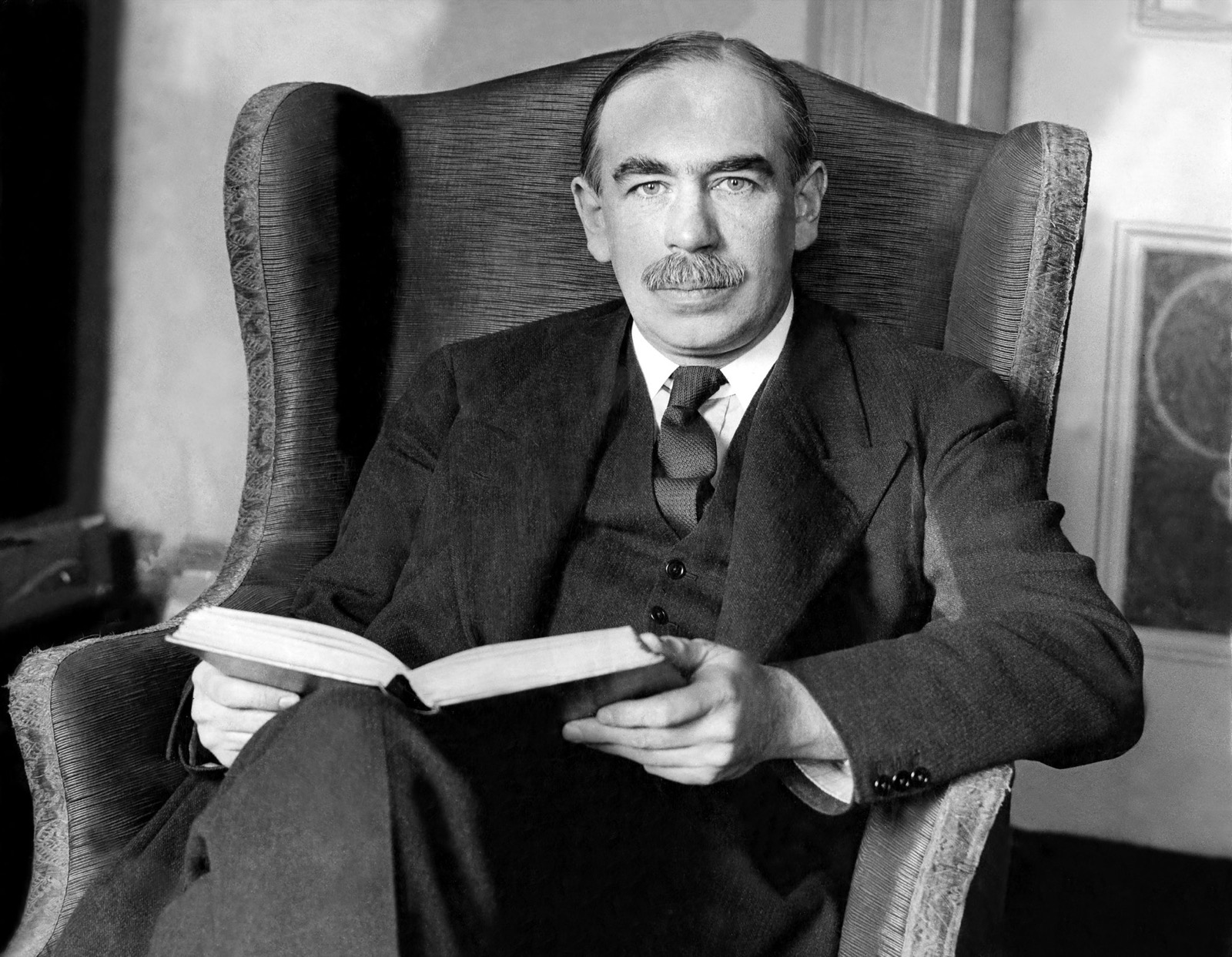

In 1930, at the start of the Depression, John Maynard Keynes published a short essay called Economic Possibilities for our Grandchildren. He coined a phrase for the anxiety of his moment, "technological unemployment", which he defined as "unemployment due to our discovery of means of economising the use of labour outrunning the pace at which we can find new uses for labour"4. He treated it as a temporary phase of maladjustment. His bigger claim was that, assuming no major wars and no large increase in population, "the economic problem may be solved, or be at least within sight of solution, within a hundred years"4.
His hundred years run out in 2030. On the material side he was roughly right: he predicted living standards four to eight times higher, and rich countries got there. On the social side he was wrong in a revealing way. He imagined that "three-hour shifts or a fifteen-hour week" would spread the remaining work thinly4. Instead we kept working, partly because our wants grew, partly because status is relative, and partly because work turned out to carry far more than income. The passage that has aged best is the one where he worries about exactly this:
Thus for the first time since his creation man will be faced with his real, his permanent problem—how to use his freedom from pressing economic cares, how to occupy the leisure, which science and compound interest will have won for him, to live wisely and agreeably and well.
Keep that sentence in mind for the rest of this piece. Most UBI debates are about the first half, freedom from pressing economic cares. The second half, how to live wisely and agreeably and well, is where I think the post-AGI question will actually be decided.
What the cash experiments actually found
The honest case for or against basic income has to start with evidence, and there is now a lot of it. No experiment has tested a true UBI: universal, permanent, nationwide, at a level you could live on. But each study tests one piece of it, and together they are more consistent than the public debate suggests.
Finland, 2017–2018


Finland's experiment paid 2,000 randomly selected unemployed people aged 25 to 58 a monthly €560, with no conditions and no means test, for two years. The final evaluation from Kela and the Ministry of Social Affairs and Health, published in 2020, found small employment effects. From November 2017 to October 2018, recipients worked on average about six more days than the control group, against an average of 78 days employed5. A new activation policy introduced in 2018 makes even that figure hard to read. The wellbeing results were clearer. Recipients reported better economic security and better mental health than the control group5.
Critics call Finland a failure because it did not raise employment much. Supporters call it a success because it did not lower employment and people felt better. Both are reading the same table. What it showed is that unconditional money does not make people idle, and it does not by itself get them into jobs either.
The OpenResearch study, 2024
The most rigorous US study so far was run by OpenResearch and funded largely by Sam Altman. About 1,000 low-income adults in Illinois and Texas received $1,000 a month for three years, and about 2,000 control participants received $507. This is the study that shows a real labour supply effect. The study team's summary reports that recipients worked about 1.3 fewer hours a week and were about two percentage points less likely to be employed7. The latest version of the academic paper by Vivalt and colleagues reports a 4.2 percentage point fall in labour market participation, a cut of 1–2 hours a week, and earned income about $1,900 a year lower than the control group's, with partners cutting their hours by a similar amount6. The paper finds that leisure was the largest single use of the freed time, and it finds no effect on the quality of jobs people took6.
People who want to use this result as a gotcha should be careful. A slight reduction in hours from a large transfer is exactly what standard economics predicts, and it is far smaller than the "nobody will work" story. People who want to dismiss it should also be careful. The cash did not buy the large gains in health or job quality that many advocates had hoped for.
Stockton, Kenya and Alaska
- Stockton, California (SEED). 125 residents received $500 a month for 24 months starting in February 2019. The first-year evaluation reported that recipients moved into full-time employment at more than twice the rate of the control group, with reported full-time work rising from 28% to 40% against 32% to 37% in the control group. It also reported lower anxiety and depression8. The sample is small, and the pandemic distorted the second year.
- Rural Kenya (GiveDirectly). The longest-running test randomises villages into a 12-year stream of about $0.75 per adult per day, a two-year stream, or a lump sum. Short-term results from Banerjee, Faye, Krueger, Niehaus and Suri found more enterprises and higher revenues. Total labour supply did not change, but it shifted from wage work towards self-employment. Lump sums performed as well as or better than monthly payments9.
- Alaska (Permanent Fund Dividend). The closest thing to a permanent, universal cash transfer anywhere. Damon Jones and Ioana Marinescu found the dividend had no effect on overall employment and raised part-time work by 1.8 percentage points, about 17%. They attributed this to the extra spending supporting local, non-tradable jobs10. The dividend is volatile: $1,702 in 2024, and $1,000 in 202511.
Unconditional money does not make people idle. It doesn't make them flourish on its own either.
The arithmetic nobody likes
Evidence on behaviour is the easy part. The hard part is the cheque. UBI is usually priced in one of two ways, and they give wildly different answers.
The gross number is real, but it misleads in one important way. If everyone receives $12,000 and most taxpayers pay it back through higher taxes, the net transfer is far smaller than the gross. What matters economically is how much is redistributed from people above the break-even point to people below it, and what happens to incentives along the way. Price a UBI as a net transfer and it looks like a large but recognisable welfare reform. Price it as a gross line item and it looks like a second federal government.
The arithmetic also forces a choice that UBI rhetoric tends to skip. A transfer can be universal, generous, or cheap, and you can have any two. Universal and generous is expensive. Universal and cheap is a dividend, not an income. Generous and cheap requires targeting, and targeting is exactly what "universal" was meant to avoid.
UBI vs NIT: the math is the same, the politics aren't
A universal basic income of B paid to everyone, funded by a flat tax rate t on other income, leaves a person earning y with B + (1 − t)·y.
A negative income tax with a guarantee B that phases out at rate t leaves the same person with exactly the same amount. The only difference is plumbing: a UBI pays everyone and taxes it back, while an NIT pays only the shortfall.
Example: $12,000 with a 30% rate breaks even at $40,000 of income under both. Below that you are a net recipient, above it a net payer.
The politics differ completely. A UBI looks huge on a budget and is easy to understand. An NIT looks small and is hard to explain. A UBI cheque arrives whether or not your paperwork is right. An NIT depends on accurate, timely income reporting, which is exactly what people in precarious work tend not to have.
The alternatives worth taking seriously
If UBI is the default answer, the alternatives are not fringe ideas. Several of them have longer intellectual histories and stronger real-world track records.
Negative income tax
Milton Friedman proposed a negative income tax in Capitalism and Freedom in 1962. It was a way to replace a patchwork of paternalistic programmes with a single cash floor run through the tax system13. As the toggle above shows, it is mathematically equivalent to a UBI with a matching tax schedule. The US Earned Income Tax Credit is a distant, work-conditioned descendant. An NIT is the version of basic income that can pass a fiscally conservative legislature, and the price is administrative fragility.
Universal basic services
In 2017 UCL's Institute for Global Prosperity proposed a different floor. Instead of cash, it would guarantee free access to shelter, food, transport and information, extending the logic of the NHS and free schooling. Its estimate was about £42 billion, or 2.3% of UK GDP, funded largely by reducing the personal tax allowance14. The argument is that services stretch further than cash because they are bought at scale and cannot be bid up by landlords. The weakness is that services ration by queue rather than by price, and that they deliver what planners think people need rather than what people choose.
Sovereign wealth and citizen dividends
The idea I find most interesting is ownership. Altman's 2021 essay Moore's Law for Everything proposed an "American Equity Fund" financed by an annual levy of 2.5% of the market value of large companies, paid in shares, plus 2.5% of the value of privately held land, paid in dollars15. The logic is that if returns shift from labour to capital, citizens should own some of the capital.
Norway is the existence proof that a nation can do this at scale. Its Government Pension Fund Global was worth just under NOK 21.3 trillion at the end of 202516, roughly NOK 3.8 million per resident. Its fiscal rule limits spending to about the fund's expected real return. Norway does not pay a cash dividend; it spends the return through the state budget. Alaska does pay one, and the dividend shows the political risk: once a payment exists, it becomes a line item legislators fight over every year11.
Universal basic compute
In a 2024 podcast interview Altman floated an update to his own idea, "universal basic compute", in which everyone gets a slice of a frontier model's compute that they can use, resell or donate17. It is worth taking seriously as an ownership claim on the scarce input of an AI economy. As a welfare policy it is much weaker. You cannot pay rent with inference tokens unless a market converts them to money, and once a market does that, you have reinvented a dividend with extra steps.
Money issued for being human
Emad Mostaque, the founder of Stability AI, goes further than any of the proposals above. His 2025 book The Last Economy starts from what he calls the "Intelligence Inversion": cognition, the scarce input that most well-paid work is built on, is becoming abundant and nearly free19. In an interview about the book he spelled out the uncomfortable corollary. The value of human cognitive labour, he argues, doesn't just fall towards zero. For a lot of work it may turn negative20.
His answer isn't a bigger tax-funded cheque. He points out that most money today is created by commercial banks when they lend, by his count about 91% of it20. He proposes moving that issuance away from banks and towards people, so that new money is created, in effect, for being human and flows to verified humans rather than to borrowers20. In his view this may be the only workable route if AI companies keep reinvesting every dollar in compute and never book profits that can be taxed. He pairs it with a token he calls Foundation Coin, whose proceeds would fund public compute for health, education and free access to AI20.
It's the most radical idea in this essay, and it goes straight at the arithmetic problem above. If labour income shrinks, a floor funded by taxing labour shrinks with it, and you need either ownership or issuance to fill the gap. But issuance has a well-known failure mode: money created faster than real output grows is just inflation. The scheme only works if AI makes goods and services dramatically cheaper, which is exactly Mostaque's bet. Before the first coin is minted, I'd want the issuing institution, its limits and its proof of personhood designed as carefully as a central bank. Leaving that to a token's governance forum wouldn't be enough.
The book's framing is useful even if you reject the mechanism. Mostaque describes a "Thousand-Day Window" in which societies choose between three futures: digital feudalism, a great fragmentation, or what he calls human symbiosis19. He also argues that GDP is the wrong dashboard for an economy where intelligence is nearly free. In its place he proposes a framework called MIND, which tracks material, intelligence, network and diversity capital20. I think the window is too short; institutions don't move in a thousand days. But "digital feudalism" is the most precise name I've seen for the risk the sovereign wealth section is trying to prevent.
If labour income shrinks, a floor funded by taxing labour shrinks with it.
Job guarantees and shorter weeks
A job guarantee offers public employment at a fixed wage to anyone who wants it. It addresses something cash does not, the need for structure, contribution and social contact. Its risks are the ones that sink most public employment schemes: make-work, patronage, and a fixed wage that becomes a political football. Shorter working weeks attack the same problem from the other side, spreading work rather than replacing it. The UK's 2022 four-day week pilot involved 61 companies and about 2,900 workers, and 56 of those companies continued afterwards18. That is not proof the idea scales, but it is more evidence than the fifteen-hour week Keynes predicted ever had.
| Option | What it fixes | Main weakness |
|---|---|---|
| Universal basic income | Income floor, simple and stigma-free | Very large gross cost; does not address meaning |
| Negative income tax | Same floor, smaller apparent cost | Depends on accurate, timely income data |
| Universal basic services | Housing, transport and care at scale | Queues, not choices; slow to build |
| Sovereign wealth dividend | Gives citizens a share of capital returns | Takes decades to build; dividends swing with markets and politics |
| Universal basic compute | Ownership of the scarce AI input | Not money; needs a market to become money |
| Human-based money issuance | Funds a floor without taxing a shrinking wage base | Inflation risk; needs a trusted issuer and proof of personhood |
| Job guarantee | Structure, contribution, status | Make-work and political capture |
| Shorter work week | Spreads the remaining work | Hard to apply outside salaried work |
Income is the easy part
Every option above is, in the end, a way of moving money or goods. Even if one of them worked perfectly, it would leave Keynes's second problem untouched. People get much more from work than wages: a reason to get up, a set of colleagues, a story about who they are, and a rough social ranking that tells them they matter.
The research on unemployment is fairly consistent that losing a job harms wellbeing by more than the lost income alone explains. That is why I find the cash studies' wellbeing results encouraging and incomplete at the same time. Removing financial stress makes people less anxious. It does not tell them what to do with Tuesday.
If AI really does take over most cognitively routine work, the scarce goods will be the ones that are hard to automate or that we choose not to automate. Care, teaching, craft, local politics, sport, art and companionship are all places where a human is part of the value. A good post-AGI settlement will make that work well paid and well regarded, rather than leaving it as what people do after they have been made redundant.
The political economy problem
The hardest part of all this is not designing the right policy but surviving the transition to it. Three dynamics worry me.
- Timing. Automation spreads through specific occupations and regions long before it shows up in aggregate statistics. By the time unemployment is high enough to force a national response, the communities hit first will have spent years absorbing the damage alone, which is roughly what happened with trade shocks in the 2000s.
- Concentration. If the returns to AI concentrate in a handful of firms and their shareholders, the political power to block redistribution will concentrate in the same places. Ownership stakes are easier to establish before value accumulates than after.
- Dependency politics. A transfer that everyone depends on becomes a hostage. The Alaska dividend is cut and raised in budget fights, and its value has fallen sharply in real terms. A national UBI would be the biggest political lever ever created, and whoever controls it would be tempted to use it.
None of these are arguments against acting. They are arguments for building institutions early, while the stakes are still low enough to design them carefully.
 OpenResearch

Where I land
Here is my position. I hold it firmly enough to argue for and loosely enough to change it.
First, start with ownership, not income. The deepest risk of transformative AI is not that work disappears but that the returns flow to a narrow base of capital owners while labour's share falls. The best hedge is to give the public a real stake in that capital now: a national wealth fund seeded with equity from the largest AI-exposed firms and with the proceeds of land and resource rents, run at arm's length from politics, like Norway's fund. It should pay a modest, rules-based dividend and keep the rest invested. If AI's gains are as large as optimists claim, the dividend grows into something like a basic income on its own. If they are as modest as Acemoglu expects, little is lost.
Second, fund services before cash. Housing, childcare, healthcare and transport are where an income floor is most easily absorbed by rising prices. Guaranteeing them directly, as the UBS proposal argues, makes any cash transfer go further and protects it from being captured by landlords.
Third, build the cash floor as a negative income tax and let it ratchet up. The arithmetic is the same as a UBI, the apparent cost is lower, and modern payroll reporting has largely fixed the administrative weakness that made the NIT unworkable in Friedman's day. Tie the guarantee to the dividend and the fund's returns, so that it rises automatically as automation's gains arrive rather than waiting for a political fight.
Fourth, treat meaning as a policy problem, not a private one. That means paying care and teaching properly, making shorter weeks easy to adopt, and funding the civic institutions where people build status outside the labour market. Keynes was right that this would turn out to be the permanent problem. He was wrong to think we would drift into solving it.
The steelman of the full UBI position is that this is too timid. If the disruption comes fast, a fund that takes decades to mature will be too small when we need it, and only a large, simple and universal cheque can be built quickly enough. I take that seriously. My answer is that the institutions I am describing can scale up quickly once they exist, and very little else can be built quickly from scratch. The worst outcome is to arrive at the moment of need with nothing but a spreadsheet and a slogan.
So, what comes after AGI? Probably not a single policy. More likely it is a stack: ownership at the bottom, services in the middle, a cash floor on top, and a culture that finally takes seriously the question Keynes asked almost a century ago.
Frequently asked questions
What is universal basic income?
Universal basic income is a regular cash payment to every adult, with no means test and no work requirement. It differs from targeted welfare in that everyone receives it, and higher earners pay it back through the tax system.
Does basic income make people stop working?
Not in the experiments run so far. Finland found small positive employment effects, Alaska's dividend had no effect on overall employment, and the 2024 OpenResearch study found recipients of $1,000 a month worked about 1–2 fewer hours a week. Effects on wellbeing were more consistently positive.
How much would a UBI cost in the United States?
Paying roughly 260–270 million adults $12,000 a year would cost about $3.2 trillion gross, close to half of 2025 federal outlays. The net cost is much lower once higher earners pay the benefit back through taxes.
What is the difference between UBI and a negative income tax?
With matching parameters they leave every household with the same final income. A UBI pays everyone and taxes it back, while a negative income tax only pays people whose income falls below a threshold. The difference is administrative and political, not mathematical.
What are the main alternatives to UBI after AGI?
The main alternatives are negative income taxes, universal basic services, sovereign wealth funds that pay citizen dividends, ownership of AI compute, job guarantees and shorter working weeks. Many proposals combine several of these rather than relying on one.
What does Emad Mostaque propose in The Last Economy?
Mostaque argues that AI is making cognition abundant and nearly free, which he calls the "Intelligence Inversion". Instead of a tax-funded basic income, he proposes shifting money creation away from commercial banks so that new money is issued to verified humans, and he suggests replacing GDP with a broader measure he calls MIND (material, intelligence, network and diversity capital).
References
- Eloundou, Manning, Mishkin & Rock, GPTs are GPTs: An Early Look at the Labor Market Impact Potential of Large Language Models (2023). arxiv.org ↩
- Acemoglu & Restrepo, Tasks, Automation, and the Rise in U.S. Wage Inequality, Econometrica 90(5) (2022). econometricsociety.org ↩
- Acemoglu, The Simple Macroeconomics of AI, NBER Working Paper 32487 (2024). nber.org ↩
- Keynes, Economic Possibilities for our Grandchildren (1930), in Essays in Persuasion. econ.yale.edu ↩
- Ministry of Social Affairs and Health (Finland) & Kela, Results of the basic income experiment: small employment effects, better perceived economic security and mental wellbeing (2020). stm.fi ↩
- Vivalt, Rhodes, Bartik, Broockman, Krause & Miller, The Employment Effects of a Guaranteed Income: Experimental Evidence from Two U.S. States, NBER Working Paper 32719 (2024, revised). nber.org ↩
- OpenResearch, Unconditional Cash Study (2024). openresearchlab.org ↩
- Stockton Economic Empowerment Demonstration, Guaranteed Income Increases Employment, Improves Financial and Physical Health (2021). stocktondemonstration.org ↩
- Banerjee, Faye, Krueger, Niehaus & Suri, Universal Basic Income: Short-Term Results from a Long-Term Experiment in Kenya (2023). conference.nber.org ↩
- Jones & Marinescu, The Labor Market Impacts of Universal and Permanent Cash Transfers: Evidence from the Alaska Permanent Fund, AEJ: Economic Policy 14(2) (2022). aeaweb.org ↩
- Alaska Department of Revenue, Department of Revenue Announces 2025 Permanent Fund Dividend Amount (2025). dor.alaska.gov ↩
- Committee for a Responsible Federal Budget, CBO Estimates 2025 Deficit Totaled $1.8 Trillion (2025). crfb.org ↩
- Friedman, Capitalism and Freedom (1962), ch. 12, “The Alleviation of Poverty”. wikipedia.org ↩
- UCL Institute for Global Prosperity, Social prosperity for the future: A proposal for Universal Basic Services (2017). ucl.ac.uk ↩
- Altman, Moore’s Law for Everything (2021). moores.samaltman.com ↩
- Government of Norway, Annual white paper on the Government Pension Fund (2026). regjeringen.no ↩
- Business Insider (via Basic Income Canada Network), OpenAI’s Sam Altman has a new idea for a universal basic income (2024). basicincomecanada.org ↩
- Autonomy, The results are in: the UK’s four-day week pilot (2023). autonomy.work ↩
- E. Mostaque, The Last Economy: A Guide to the Age of Intelligent Economics (Intelligent Internet, August 2025). books.google.com ↩
- "Emad Mostaque: Why GDP & Capitalism Is Obsolete in an AI World," Impact Theory with Tom Bilyeu (2025), transcript. singjupost.com ↩
Discussion
No comments yet. Start the conversation.